
posters

Shear-Thickening, Self-Healing Hydrogels for Smarter Drug Delivery
In this project, we characterized shear-thickening, self-healing tetra-PEG hydrogels formed through dynamic hydrazone chemistry. Rheometry showed that all formulations exhibited strain stiffening at the same critical strain, revealing that the shear-thickening behavior is inherent to the polymer network, not the specific polymer functionalization percentage. We also demonstrated that mechanical stiffness can be used as a proxy for polymer functionalization, offering a simple alternative to NMR.
Encapsulated cells maintained high viability after 1 day, confirming the material’s cytocompatibility and potential as a gentle carrier for sensitive payloads. These results highlight a promising platform for injectable delivery of proteins, stem cells, and other fragile therapeutics, motivating further exploration of chemistries and long-term stability.
For more information, see Bite-Sized Science
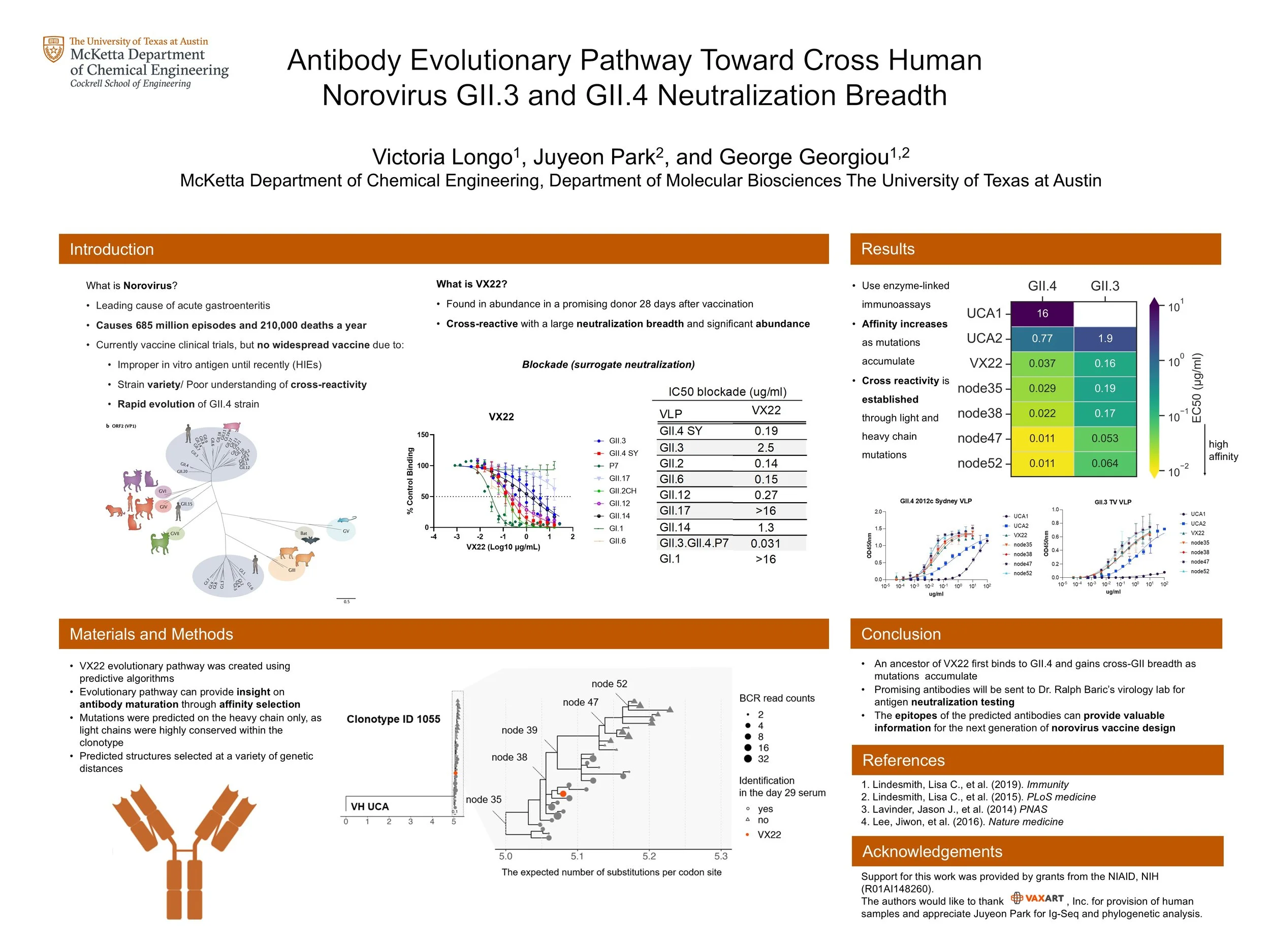
Evolving Broadly Neutralizing Antibodies Against Norovirus
Norovirus rapidly mutates and disproportionately affects young children, older adults, and immunocompromised people—90% of children are infected at least once by age five. To identify antibodies with true neutralization breadth, we used predictive modeling to reconstruct an antibody’s evolutionary pathway and tested key variants along the clonal tree.
The original vaccine-elicited antibody had low affinity and no cross-reactivity, but as predicted mutations accumulated—mirroring natural affinity maturation—both affinity and cross-reactivity to GII.3 and GII.4 increased. One evolved variant, VX22, showed the strongest performance, with high affinity and broad neutralization potential. Additional model-guided mutations further improved binding to both strains.
Promising antibodies were engineered as monoclonal candidates and sent to Dr. Ralph Baric’s lab for full neutralization testing. These insights help guide next-generation norovirus vaccine design aimed at protecting the most vulnerable from this highly mutating virus.
For more information, see Bite-Sized Science